
What Happens to Your Steam Library When You Pass Away?
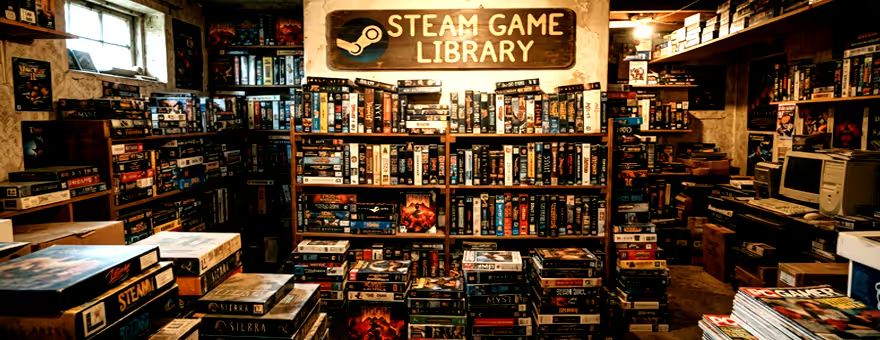
The Steam Library
For starters, The Steam Library is not a physical library. Rather, it is more of a storage information allocation in the vast and complex digital data storage site within the overall Internet cloud structure known as the “Steam Game Platform”. For the uninitiated, Steam is a digital gaming storefront where one can purchase games online and download it as a whole, which you can either play by yourself with no Internet connection or online with others on the Internet. However, every game you purchase, or offered free games you add to your Steam Library which comes with your Steam Customer Account is recorded and stays there. If you need to download it again, you can get it from there with no extra charge since you already paid for it.
The Steam Library can also be metaphorically thought of as a small room (or attic) where all the games you bought from the Steam Store are organized and stored, the box packages and the disks, cartridges, CDs, DVDs and other game media inside them. In the real world and predominantly back in the 1980s and 90s, it would exist in your house and not online in the Internet. With the convenient practice of downloading games today directly from the games store, this physical games library/room is but a "Nostalgic' rarity these days.
The Steam Library online today lets you manage your entire gaming collection from a single interface, it lets you install newly acquired titles, launch your games, view your unlocked in-game achievements, track your total playtime, and manage downloadable content (DLC) or modifications. What's more, it serves as an active dashboard that connects you to the broader Steam gaming community. It also contains other gaming information like recent developer updates, news, patch notes, and community content like screenshots and guides created by other gamers. Also, it allows you to sort your collection into customized categories, separate games by genre or play state, and share your titles with friends and family through Steam's sharing features.
The Advantage of The library
One of the main functions of The Steam Library is to keep your games updated and ensure your titles are always ready to play across any PC or compatible device. This integrated function enhances your gameplay through features like the "Steam Overlay" for mid-game web browsing and chatting, unlocking your achievements and tracking your playtime and player statistics. These may not seem much important for a grandma gamer if you just play the games offline by yourself, but when playing online within the entire gaming community framework, they do.
Also, the library provides a seamless access to the "Steam Workshop" in case you want to play game mods, as well as "Steam Family Sharing" that lets you share your digital game collection with trusted family members easily.
You Stop Breathing!
To everybody, the dreaded day will always come. The day you stop breathing. However, each and every one has one’s own time to face one’s maker, and the thing is, no one can really practically tell when. So, in the eventuality one never gets to sit in front of one’s PC again, and log into one’s Steam Library ever again, then, one has a problem, or rather, those left behind have a problem.
According to the “Steam Subscriber Agreement”, a user’s account and the digital contents connected to it are “Non-Transferable”. When you purchase a game from online game stores like Steam, you actually purchase a personal license to play that game and not the actual packaged boxed game like the ones in the home games library of the 1990s. Because the games in your Steam Library are tied to your user account, they cannot be legally transferred to your next of kin (your family, your relatives, or your dog and cat). This is legally binding and even if your little granddaughter hires an attorney, she will not be able to legally transfer all of grandma's games in her Steam Library to hers.
On the Steam platform, nothing dramatically happens to the digital game collection when an account holder passes away. Valve does not actively check every now and then if a user is Dead or Alive, or automatically delete profiles, as the account simply goes inert on Steam's database servers. The library remains with the account (with everything in it) on the platform and will sit dormant forevermore unless the account holder’s family officially requests Valve to close the account for closure. Think of it like Facebook, the guy passed away a decade ago but there he is, still on Facebook.
To ensure that their games can be passed on if ever something ever happens to them and they can never log-in to Steam ever again, some gamers turn to informal workarounds to ensure their games survive them. The most common is to share one’s log-in credentials, password and all to a trusted love one so their account and games can be accessed and played even when they’re gone. Officially, and technically, it violates Steam's terms of service, but it allows family members to continue launching the games locally or use Steam Family Sharing to play the collection from their own personal accounts. Unfortunate as it is, those games have been paid for and from a moral standpoint, a user has every right to pass their game collection to someone they love just like the “boxed” old games stacked in the attic or home games library.